
Fixed-fee work in Feng Office 4 adds a proper fixed-fee category to time entries in Feng Office. Hours logged against fixed-fee tasks stay visible in utilization and labor reports, separate from non-billable administrative time, so project profitability is always accurately reflected.
Fixed-fee hours that stay visible
without affecting what you bill
Fixed-fee tracking
Non-billable split
Visible in reports
Accurate margins
Complete hours
Version 4 separates fixed-fee effort from non-billable time, so project managers can track real labor costs without losing data in the reports
Fixed-fee contracts are common in professional service firms. A firm agrees to deliver a defined scope for a set price, regardless of how many hours it takes. The team still logs time against those tasks, not to bill the client, but to understand how much effort the work actually required. That data matters for evaluating project profitability, calculating effective bill rates, and pricing similar work in the future.
The problem is that when fixed-fee tasks are marked as non-billable, which is what Feng Office required before Version 4, those hours disappear from the reports. They don’t show up in utilization. They don’t factor into labor analysis. They exist in the system but contribute nothing to the picture of how the project actually performed. And without that data, project managers are making decisions about profitability and future pricing with an incomplete view of where the time went.
What changed in Version 4
Version 4 introduces a proper fixed-fee category for time entries, separate from non-billable. When a task is marked as fixed-fee, time entries logged against it are categorized accordingly. They are not sent to the client on an invoice, but they remain fully visible in utilization and labor reports. The hours count toward the team’s tracked effort, they appear in project performance analysis, and they contribute to the calculation of the effective bill rate and overall project profitability.
The distinction sounds simple, but the effect on reporting is significant. Fixed-fee hours are real work. They represent the effort your team put into a deliverable that the client paid for at a set price. Treating them the same as administrative non-billable time, like internal meetings or training, was always inaccurate. Version 4 corrects that.
How it works in practice
Marking a task as fixed-fee
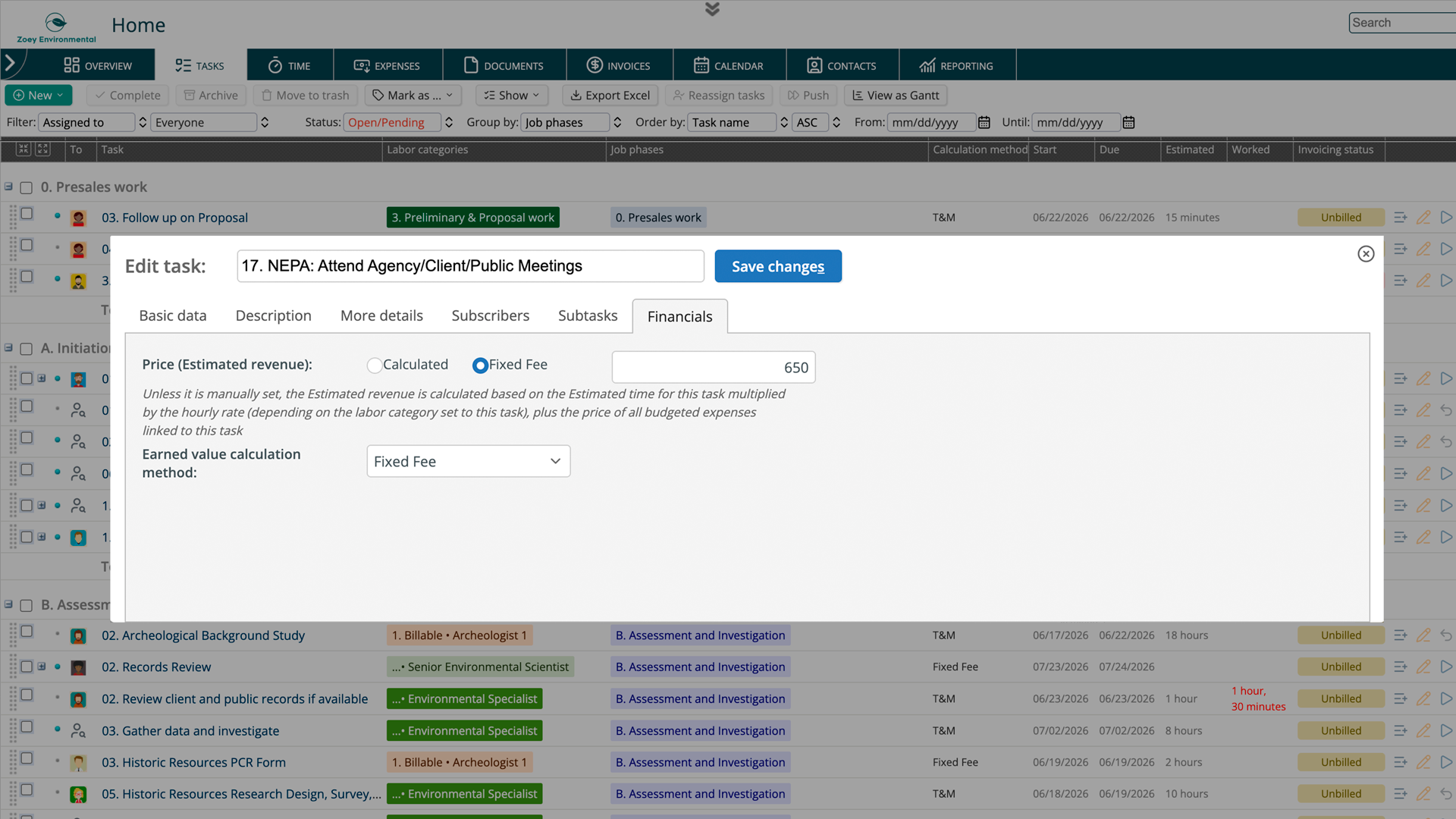
When a task is set as fixed-fee, all child tasks under it inherit that status automatically. This keeps the data clean across the full task structure without requiring someone to manually categorize every sub-task. The parent task defines the billing type, and the hierarchy follows.
Logging time against fixed-fee tasks
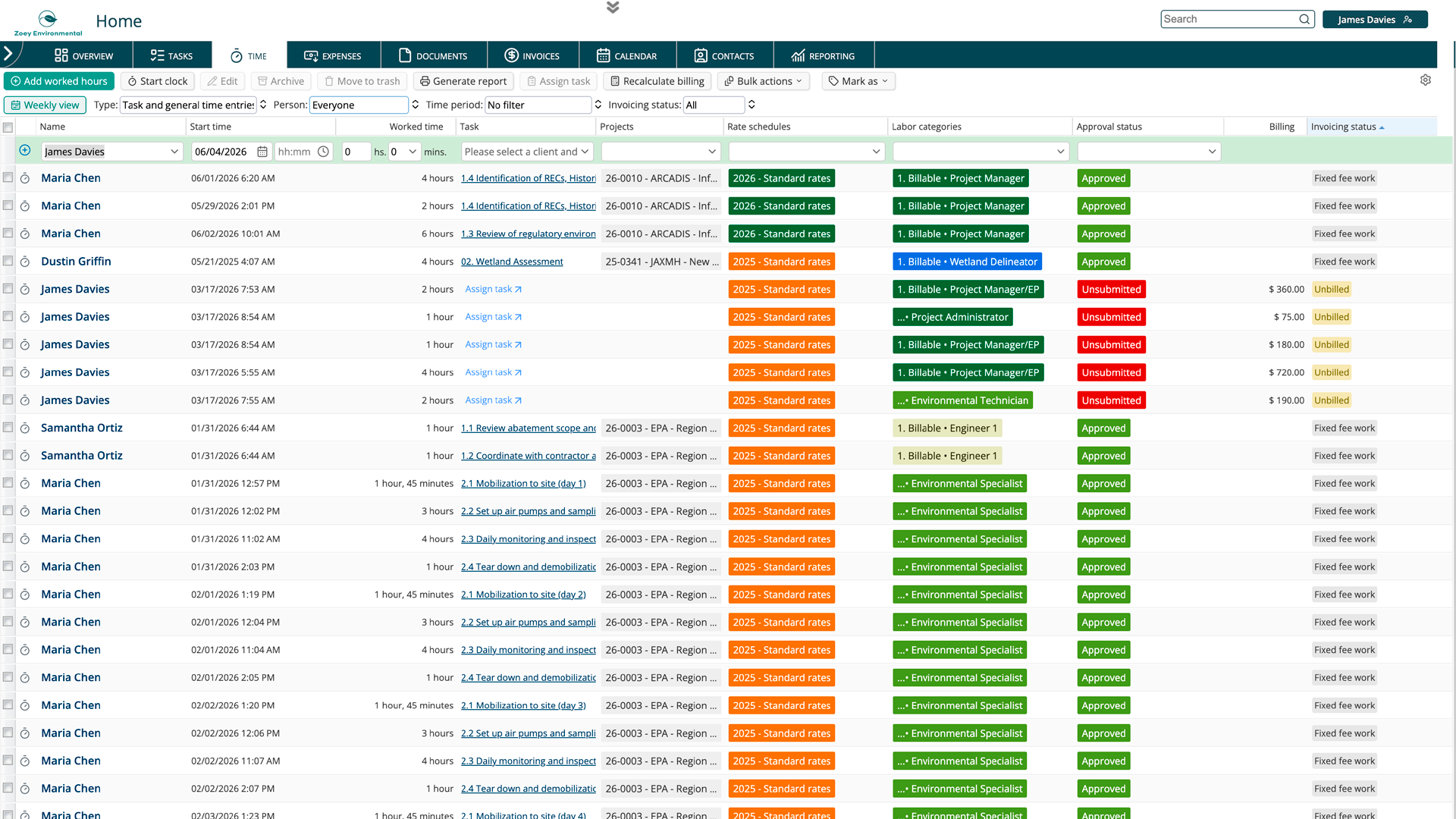
Team members log time against fixed-fee tasks the same way they log any other time entry. The difference is in how that time is handled by the system. It does not flow to billing or appear as a billable amount on an invoice, but it does appear in the reports that track effort, utilization, and labor cost, giving project managers an accurate view of what the fixed-fee scope actually costs to deliver.
What stays separate
Non-billable time, the kind that covers internal overhead, administrative tasks, or time that simply isn’t part of any client engagement, remains its own category. Fixed-fee hours and non-billable hours are now distinct in Feng Office, which means reports can show each type separately, and project managers can see the real breakdown of how time was spent across a project.
Why this matters for project profitability
The effective bill rate on a fixed-fee project is only meaningful if all the hours that went into delivering it are counted. If fixed-fee hours were being lumped in with non-billable time and excluded from reports, the effective rate was always overstated because the denominator was missing hours. With Version 4, those hours are in the reports, and the profitability picture is accurate.
For firms that use historical project data to price future work, the accuracy has a direct impact on the quality of their estimates. A firm that knows a certain project type historically requires a specific number of fixed-fee hours to deliver can price the next one with confidence. A firm working from incomplete data is guessing, even if it doesn’t feel that way.
In short
Version 4 separates fixed-fee time entries from non-billable administrative time, so hours logged against fixed-fee tasks stay visible in utilization and labor reports without appearing on client invoices. Project managers get an accurate view of effort, effective bill rates, and project profitability, built on complete data rather than a version of the numbers with fixed-fee hours quietly missing.
Book a private tour
See how fixed-fee hours show up in your project reports
The difference between having fixed-fee hours in your reports and having them silently excluded is a difference in how reliable your profitability data actually is. You tell us how your firm currently tracks effort on fixed-fee work, and we’ll show you exactly how Version 4 handles it.
- See fixed-fee time entries logged and traced through to utilization and labor reports in a live project
- Walk through how the fixed-fee category differs from non-billable and how each appears in reporting
- Ask anything about how child tasks inherit fixed-fee status and how billing is kept separate
- Get a clear picture of what your profitability reporting looks like with complete hours included before you commit to anything
About Feng Office
Built for the way project-based firms actually operate
Feng Office is not a generic project management tool with a few extra fields. It is a business management platform built specifically for project-based firms, where projects are complex, billing structures vary, and the people doing the work are often the same people managing it.
We are software experts, not project delivery professionals. Our job is to understand the operational reality of running a project-based firm and build tools that clear the administrative path, so your team can stay focused on the work that actually matters.
100%
Human support during implementation and beyond
1
Platform for projects, billing, invoicing, and reporting
PBF
Built exclusively for project-based firms
4.0
The most complete version we have ever shipped
⚙
Everything connected
Tasks, time entries, expenses, billing, and financial reporting live in one place. Nothing gets lost between the project and the invoice.
◎
Built for complexity
Multiple service lines, variable billing structures, work that doesn't fit a generic template. Feng Office was designed around that reality, not adapted to it.
↗
Visibility at every stage
You stop finding out a project is over budget after the invoice goes out. The reporting module shows where each project stands on budget, schedule, and billing at any point.
◈
Support that walks with you
Implementation is not a handoff. Our support is 100% human, and we are present during setup, onboarding, and every step after that.
⊞
One platform, not three systems
Data in one place, invoices in another, reports in a third. Feng Office replaces that with a single working environment where everything connects.